Latest Entries

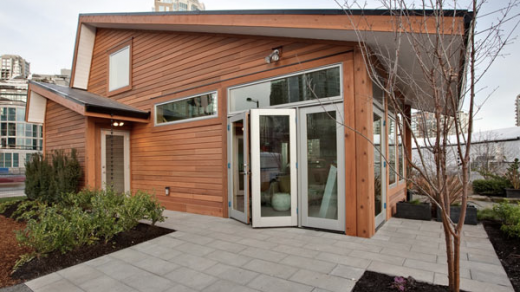
West House opens in Vancouver

West House, the SFUsustainable laneway home, opened to much public and media interest March 8 in Vancouver. It showcases leading-edge small footprint residential design, energy efficient, integrated systems and interactive technologies that encourage a sustainable lifestyle.   Chief among these is the ALIS integrated resource management information system that supports the residents in making better decisions about the use of energy and water.

The West House project is championed by SFU and the HCSSL team; BC Hydro Power Smart; the City of Vancouver; and Western Economic Diversification, Government of Canada. Partners in West House include Smallworks Studios and Laneway Housing; Day4 Energy (the solar PV panels); FortisBC (natural gas), Canadian Solar Technologies (solar thermal); Embedded Automation (the control system);  Moscone Brothers and Durante Kreuk Landscape Architects (landscaping); Pulse Energy; and Autodesk Research.

Canadian green building centre to open in China

A recent press release in the Vancouver Observer announced the development of the Net Zero Canadian Research and Development Centre, that “will demonstrate Canada’s capabilities in green building technologies, and serve as a one-stop location for Canadian technology companies in China.” Located in Tianjin, China, the project is a joint venture between Vancouver-based Global Green, EnVision Shanghai, and the Sino-Singapore Tianjin Eco-City.

The City of Vancouver’s Sustainability Group is involved with the project and will be providing support in the form of educational programs and resources, as well as facilitating involvement from within the Vancouver green building industry. Construction of the centre is planned to begin in 2011.

The full release is available at: http://www.vancouverobserver.com/blogs/cityhall/2010/09/14/canadian-green-building-centre-open-china.

Architect Magazine recognizes North House with a 2010 R&D Award

North House has been awarded a 2010 R&D Award by Architect Magazine. These jury-selected awards are based on criteria of performance, aesthetics, and progressive thinking. The writeup for the award focuses on the Adaptive Living Interface System (though the interactive systems are misattributed to the University of Waterloo rather than SFU – students and faculty from Waterloo were responsible for the architecture and engineering of North House, while our team undertook the interactive design). From the article:

Any architect pursuing LEED points knows that the actions of the occupant can have more impact on a building’s energy performance than any single technology, so the student design team from the University of Waterloo concentrated on developing a building management system—called the Adaptive Living Interface System (ALIS)—that is both easy to use and informative. The program collects data and monitors energy use and production, water use, and indoor and outdoor environmental conditions. This information can be accessed via a Web-based application that parses the data and can track patterns over months or years.

Since changes can be made and monitored in real time, touchscreen panels are integrated throughout the house and translate information into a dollar figure of savings or expenditures for the day. And to make monitoring simple, the design team based the system on open-source calendar and social networking softwares that are easy to use and require no new learned skills. It was this level of integration that intrigued juror Cristobal Correa. “They looked at all the systems and they talk about the user. It’s very important for these things to actually interact with the user—this house is like a living thing,” he said.

The 2010 awards are published in the August issue of the print magazine, and the article on North House is available online at http://www.architectmagazine.com/green-design/2010-rd-awards-north-house-responsive-envelope-prototyping.aspx. Way to go Team North!

Participants needed for research study

Early in September, one of our research group members will be running a study to explore the design requirements for ambient and artistic visualization of residential resource use. We are currently recruiting participants for the study. Individuals wishing to participate must be 19+. The study will take approximately 1 hour to complete, and participants will be entered into a lottery for a $300 gift certificate in recognition of their contribution.

If you or someone you know might be interested in participating, please let us know! Contact Johnny Rodgers at jgr3 at sfu dot ca.. Clicking on the advertisement below will load a PDF version of the document. Feel free to post and circulate!

AdvertisementForParticipants

New Publications: UbiComp Workshop paper and InfoVis poster

Notification of two new publications has recently come down the pipeline for the research group. The first is a workshop paper that we will present at UbiComp 2010 in the Ubiquitous Computing for Sustainable Energy workshop. The second is a poster on our framework for the design of residential resource use feedback that has been accepted to InfoVis 2010. We look forward to discussing the work with our colleagues in Copenhagen and Salt Lake City!

L. Bartram, J. Rodgers, R. Woodbury. “Supporting Sustainable Living: Aware Homes and Smart Occupants.” Proceedings of UbiComp 2010, Workshop on Ubiquitous Computing for Sustainable Energy.

Awareness of resource consumption in the home is a key part of reducing our ecological footprint, yet lack of appropriate understanding and motivation often deters residents from behaviour change. We report on the design and implementation an in-home system that supports residents in awareness of resource use, facilitates efficient control of house systems, and encourages conservation in daily activities. Initial responses from deployments in two high-profile sustainable homes indicate the potential this holistic approach has in engaging residents in sustainable living. We present the design rationale for our approach, and discuss the challenges and opportunities we have addressed.

J. Rodgers, L. Bartram. “Visualizing Residential Resource Use: A Framework for Design.” Proceedings of InfoVis 2010.

Effectively visualizing residential resource consumption is a key challenge of environmental conservation efforts. However, existing approaches have relied on a variety of assumptions about effective techniques without a unifying theoretical foundation, a set of criteria for categorizing different approaches, or a means of evaluating the strengths and weaknesses of each. This is a design space in need of some structure. To this end, we present our ongoing work to construct a comprehensive framework for the design and analysis of information visualization techniques for the provision of feedback on residential resource use. This is intended to serve both the investigation of existing instances and the design of future systems. It is our hope that continued refinement of this framework will deepen our understanding of effective approaches, and establish a common set of terms to characterize the field.

ALIS poster to be presented at UbiComp 2010

Johnny and Lyn recently received notification that their poster submission has been accepted to UbiComp 2010 in Copenhagen, Denmark! The poster presents the motivation and design rationale behind ALIS, the Aware Living Interface System, that has been deployed in North House and West House. The major components of the system are presented, and a few of the lessons learned are discussed. The abstract will be available in the conference proceedings, and archived in the ACM Digital Library.

J. Rodgers, L. Bartram. “ALIS: An Interactive Ecosystem for Sustainable Living.” Proceedings of UbiComp 2010.

Engaging occupants in conservation efforts is a key part of reducing our ecological footprint. To this end, we have developed the Aware Living Interface System (ALIS), an integrated in-home system that supports residents in awareness of resource use, facilitates efficient control of house systems, and encourages conservation in daily activities. Initial responses from deployments in two high- profile sustainable homes indicate the potential and challenges involved in supporting sustainable living.

Connecting the Digital Home to the Smart Grid

One of our primary industry partners, Embedded Automation, has released a video demonstrating their new products for smart grid integration. Connecting the Digital Home to the Smart Grid presents their mStation and mBee products, which use ZigBee networking technology to connect and manage home appliances and communicate with the smart grid.

A prototype of the mStation hardware was used in West House during the Olympics, alongside Embedded Automation’s mControl software and VerTech Solution‘s VerHub.

Chasing the Negawatt featured in Computing Now

image_galleryOur article, Chasing the Negawatt: Visualization for Sustainable Living, is featured in this month’s issue of Computing Now, a Web site featuring content from the IEEE Computer Society’s 13 magazines. This feature makes the article freely accessible online for a month. Check it out!

North House featured on CBC Radio’s Spark

This week, North House was featured on Spark, CBC Radio’s technology and culture show. Host Nora Young spoke with Lisa Rochon, Globe and Mail architecture critic, about responsive architecture, using North House as an example of what’s possible:

Imagine window blinds that shut themselves when it gets too sunny. Or a house that knows when you’re coming home from a winter vacation.

Ideas like this are part of a new movement in building design: responsive architecture. Responsive architecture is actually already beginning to become a reality in the actual buildings around us. Lisa Rochon is the architecture critic at the Globe and Mail and she talked to Nora about Canadian developments in responsive architecture.

University of Waterloo faculty lead Geoffrey Thün is briefly interviewed in the piece.

Scroll down the feature listing for Spark 117 and you can listen to the segment under the heading Responsive Architecture (Runs 11:16).

The full MP3 of the Podcast is available here, or in the Apple iTunes Store.

“Chasing the Negawatt: Visualization for Sustainable Living” Published

Our paper, Chasing the Negawatt: Visualization for Sustainable Living, has been published in this month’s issue of IEEE Computer Graphics & Applications. It is available from the publisher and in the ACM Digital Library. Our sincere thanks to Theresa Marie-Rhyne and Dennis Taylor for their support and for editing and helping us prepare the document for publication.

L. Bartram, J. Rodgers and K. Muise. “Chasing the negawatt: Visualization for Sustainable Living.” IEEE Computer Graphics and Applications, 30 (3), pp. 6-12, 2010.

Information visualization has an important role in enabling residents to understand and manage their use of resources in the home. Existing solutions designed for building managers in industrial and commercial contexts don’t account for the diverse factors at play in effective visualization of residential energy consumption. Such factors include placement, visibility, aesthetics, and integration with an information and visualization ecosystem. To provide a viable solution for homes, researchers developed the Adaptive Living Interface System (ALIS). ALIS is the interactive computing and information visualization backbone of North House, a net-zero home that placed fourth in the 2009 Solar Decathlon. This combination of green building methods with pervasive visualization technologies could be a powerful vehicle for encouraging conservation in a residential setting. However, simply transferring current approaches into the residential environment is inappropriate. Also, evaluation of these techniques involves myriad challenges.


© All material copyright of the HCSSL Research Group and its respective authors, 2009-10.
This site is proudly powered by Wordpress and uses a modified version of the Modern Clix theme.

Simon Fraser University School of Interactive Arts & Technology